Buying Horse Property in Lexington
What separates Lexington-area horse farms, from breeding and training infrastructure to usable acreage and the distinct markets around Versailles, Midway, Paris, and Georgetown.
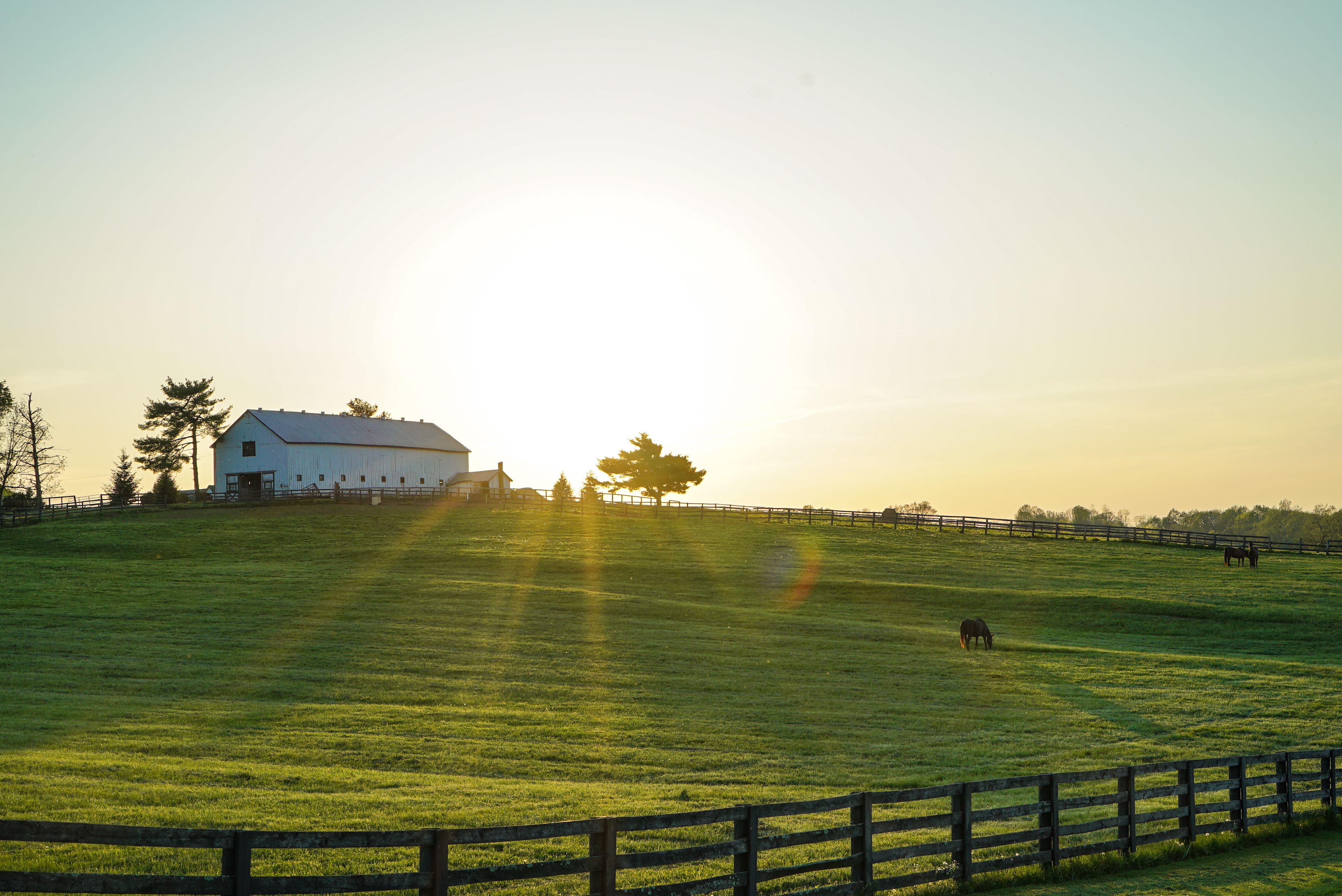
Lexington, Kentucky
TL;DR
Lexington is the center of a wider horse-farm region whose surrounding markets serve different operations and budgets. Buyers should compare the land, barns, training and breeding infrastructure, access, and daily workflow against their intended use rather than treating every property marketed as a horse farm as equivalent.
Search “Lexington equestrian real estate” long enough and the results stop being about Lexington. They start pointing to Versailles, Midway, Paris, Georgetown, Nicholasville — properties in Woodford County, Bourbon County, Scott County, Jessamine County. That isn’t a sign the search is broken. It’s a sign the search is working correctly, because Lexington isn’t really a single-city horse-farm market. It’s the recognized center of a much larger one.
Fayette County, where Lexington sits, holds some of the region’s most storied farm ground — but a meaningful share of the Bluegrass’s working farms, breeding operations, and private equestrian estates sit just outside it, in the surrounding counties that make up Central Kentucky horse country. Understanding that structure before evaluating individual properties changes what you’re actually looking for.
Lexington Is the Center of a Region, Not the Whole Market
Lexington and Fayette County anchor the Bluegrass equestrian economy — proximity to Keeneland, the Kentucky Horse Park, and the dense concentration of trainers, veterinarians, and bloodstock services that cluster around a working Thoroughbred industry. But acreage inside Fayette County is limited and long spoken for, and much of the region’s farmland, including some of its most significant breeding and training operations, lies in the counties that ring it.
A buyer who confines the search strictly to Lexington proper is working with a narrower and often less suitable set of properties than one willing to look at Woodford, Bourbon, Scott, or Jessamine counties — all of which function as part of the same practical market, share the same equine infrastructure, and sit within an easy drive of Lexington’s core.
The Surrounding Markets Serious Buyers Should Understand
Versailles and Woodford County hold one of the highest concentrations of farms in the entire region — from large legacy breeding operations to smaller private estates, with acreage and infrastructure that reflect decades of continuous equestrian land use. For buyers seeking a serious working farm or an established equestrian estate, Woodford County is frequently where the search leads.
Midway sits within the same Woodford County horse country, with a smaller-town character and a rural setting shaped by the farms around it. It’s often part of the same search as Versailles for buyers wanting proximity to that concentration of farm ground without competing directly for the largest legacy properties.
Paris and Bourbon County carry a long-standing agricultural and equestrian identity of their own, with larger farms and a working-land character that reflects the county’s role as one of the Bluegrass’s original horse-farming areas.
Georgetown and Scott County extend the search north of Lexington, offering another concentration of acreage and farm properties for buyers willing to widen the radius.
Nicholasville and Jessamine County round out the search to the south, another part of the broader Lexington-area acreage and equestrian market worth including rather than overlooking.
None of these places are substitutes for one another. Each has a different character, a different concentration of farm types, and a different relationship to the industry infrastructure clustered around Lexington — which is exactly why the right property for one buyer is often in a different county than the right property for another.
Not Every “Horse Farm” Is the Same Property
“Lexington horse farm” gets used loosely, and it covers genuinely different kinds of property. A private horse property built for a single family’s personal horses has little in common, functionally, with a commercial breeding operation — even if both are technically horse farms on paper.
Worth distinguishing before evaluating anything:
- Private horse property — personal-use acreage built around a small number of horses, without commercial activity
- Recreational acreage — land suited to trail riding or casual ownership rather than a working operation
- Small training farms — properties built around a working training program rather than ownership alone
- Sport-horse facilities — farms configured for hunter/jumper, dressage, or eventing rather than racing
- Thoroughbred breeding farms — properties built around broodmares, stallions, foaling, and the seasonal rhythm of a breeding operation
- Commercial equestrian operations — boarding, training, or sales-prep businesses with the zoning and infrastructure that requires
- Large legacy farms — longstanding properties with decades of continuous equine infrastructure and history
- High-end equestrian estates — residences built to a high standard alongside serious equestrian facilities
Not every farm in this region is connected to Thoroughbred racing, and it’s a mistake to assume otherwise. The Bluegrass equestrian economy includes sport-horse operations, private recreational properties, and boarding and training businesses that have nothing to do with the racing and breeding industry Lexington is best known for. The industry’s presence shapes the region’s infrastructure and expertise, not every individual property in it.
How Intended Use Changes the Search
The type of horse operation you intend to run changes almost every criterion that matters on a property. A private owner keeping a few personal horses needs a fundamentally different property than:
- a breeding operation, where foaling stalls, broodmare barns, and stallion facilities matter as much as pasture,
- a training operation, where arena or track access and turnout efficiency for a working string of horses take priority,
- a sales-prep operation, where facilities suited to conditioning and presenting horses for sale become central,
- a sport-horse buyer, whose needs center on arena footing and construction rather than broodmare infrastructure,
- or a commercial boarding business, which has to satisfy zoning and access requirements a private owner never encounters.
Two farms with identical acreage can be entirely mismatched to different buyers. A property configured around shed-row barns and foaling stalls suits a breeding operation and may be nearly irrelevant to a dressage rider who needs a properly built outdoor arena instead. Before touring properties, it’s worth being specific about which of these categories actually describes your intended use, because it determines which farms are even worth evaluating.
Evaluate the Operation, Not Just the Residence
The house on a horse farm is often the least important part of the evaluation, and it’s the part that gets the most attention. A visually impressive house should not overshadow deficiencies in the land or equestrian facilities — because the facilities, not the residence, determine whether the farm can actually function for its intended use.
Worth evaluating directly, on the ground rather than from listing photos:
- Usable pasture versus total acreage — rolling Bluegrass pasture varies in quality and drainage, and total acreage tells you nothing about how much of it is actually usable for turnout
- Pasture rotation and fencing layout — whether the paddock system supports proper rotation, or whether it was laid out without an operating plan
- Barn placement and stall configuration — shed row, center-aisle, foaling stalls, broodmare or stallion barns, and whether the layout matches your intended use
- Turnout efficiency — how horses actually move between barn, paddock, and pasture, not just how many acres exist on paper
- Water availability — wells, ponds, creeks, and automatic waterers, and whether supply is reliable rather than seasonal
- Drainage and mud management — limestone-region soils and rolling terrain create real differences in how paddocks and gateways hold up through wet Kentucky winters
- Fencing condition — four-board fencing is the regional standard for a reason, and its condition and placement matter as much as its presence
- Farm-road condition and trailer circulation — whether trailers and equipment can actually move through the property without a workaround
- Hay storage and equipment access — often underbuilt on properties that otherwise look complete
- Caretaker or manager housing — relevant for any operation larger than a strictly private one
- Veterinary access — proximity to equine hospitals and specialists, which matters more for breeding and training operations than for recreational ownership
A 40-acre property can function poorly if the barns, paddocks, and access were laid out without an operating plan — and a smaller, well-configured property can outperform a larger one that was never built with a working system in mind. Buyers should evaluate the farm as a working system, not as a residence with horse amenities attached to it.
For larger or professional operations, this infrastructure isn’t a cosmetic consideration — it materially affects what the property can actually generate and how much it will cost to run. Maintenance costs, expansion potential, and even neighboring land use all factor into whether a farm remains functional and viable over time, not just whether it looks right on the day of a tour.
The Region’s Relationship to the Equine Industry
Lexington’s role as a center of Thoroughbred breeding and racing shapes the surrounding real estate market in ways that go beyond any single property. Proximity to Keeneland and the Kentucky Horse Park, the concentration of bloodstock agents, farm managers, trainers, and equine veterinary specialists, and the seasonal rhythm of sales and breeding season all influence which properties exist, how they’re built, and what kind of buyer they were built for.
That infrastructure supports far more than the racing industry alone. Sport-horse buyers, private owners, and recreational riders benefit from the same concentration of farriers, feed suppliers, and veterinary care that the Thoroughbred industry has built up over generations — even when their own use of a property has nothing to do with racing or breeding.
Lexington Versus Versailles, Midway, Paris, Georgetown, and Nicholasville
There’s no single answer to which of these areas is “better” — the right one depends on what you’re buying and why. Versailles and Woodford County suit buyers looking for the region’s deepest concentration of established farms. Midway offers a similar setting with a different scale and character. Paris and Bourbon County suit buyers drawn to larger, working-land properties with a longer agricultural history. Georgetown and Nicholasville extend the search north and south for buyers who need more acreage options than Fayette County itself can offer.
Treating these as interchangeable substitutes for one another misses the point of the regional search. Treating them as distinct markets, each with a different concentration of farm types and a different relationship to Lexington’s core infrastructure, is what actually helps narrow a search to the right property.
Why Horse Farms Require a Different Kind of Evaluation
A conventional acreage purchase asks whether the house works, whether the lot is usable, and whether the location fits daily life. A horse-farm purchase asks all of that and then asks a longer set of operational questions on top of it — about pasture, drainage, barn configuration, fencing, water, access, and whether the zoning and restrictions on the property actually permit the intended use.
Agricultural zoning, deed restrictions, and conservation easements vary by property and by county, and they can directly affect whether commercial equestrian activity, expansion, or even certain kinds of construction is possible on a given parcel. These are property-specific and county-specific questions that should be confirmed directly rather than assumed from a farm’s current use or its neighbors’ activity.
That difference — evaluating a working system rather than a residence with amenities — is what separates a horse-farm purchase from a conventional acreage purchase, and it’s the lens worth applying to every property in this search, regardless of which county it sits in.
Finding the Right Property Specialist
This page exists to help serious buyers understand how the Lexington-area equestrian market actually functions before they start evaluating individual farms — not to serve as the listing brokerage for any property in it. The right specialist for a private buyer looking for a small personal horse property is not the same as the right specialist for a breeding operation, a training business, or a buyer focused specifically on proximity to Keeneland or the Kentucky Horse Park.
If you’re evaluating equestrian property anywhere across Lexington, Fayette County, Versailles, Woodford County, Midway, Paris, Bourbon County, Georgetown, Scott County, Nicholasville, or Jessamine County, we can help identify a real estate professional whose experience matches your intended use and the specific part of the Bluegrass you’re searching in.
Talk through the assignment
Find an agent who understands this kind of property.
Tell Dalton the location, your intended use, and the details that cannot be compromised. He will help connect you with a knowledgeable equestrian real estate professional whose experience fits the property.
Describe what you need